Dating the Japanese Tradition
There is a particular kind of confidence that attaches to statements about Japan.
The cherry blossom stands for the brevity of life. Wabi-sabi is the ancient acceptance of imperfection. Japanese taste is essentially restrained. The kimono is governed by centuries of rules. Each of these claims is repeated by museums, design magazines, guidebooks and, increasingly, by Japanese institutions addressing foreigners.
All four are datable. Not to the Heian court, not to the tea room of the sixteenth century, but to a window running roughly from the 1870s to the 1990s - and in two cases to a specific exhibition and a specific book.
This is not a debunking exercise.
“Invented tradition,” in Eric Hobsbawm’s sense, does not mean fraud. It means a set of practices, usually governed by accepted rules, that establishes continuity with a suitable past - a continuity that is largely factitious even when every individual component is genuinely old. The materials in all four cases are real and often very old. What is recent is the framing: the moment when scattered materials were gathered, ranked, named, standardized, and assigned a national meaning.
That moment is worth dating precisely, because the date usually explains the shape of the thing.
Sakura
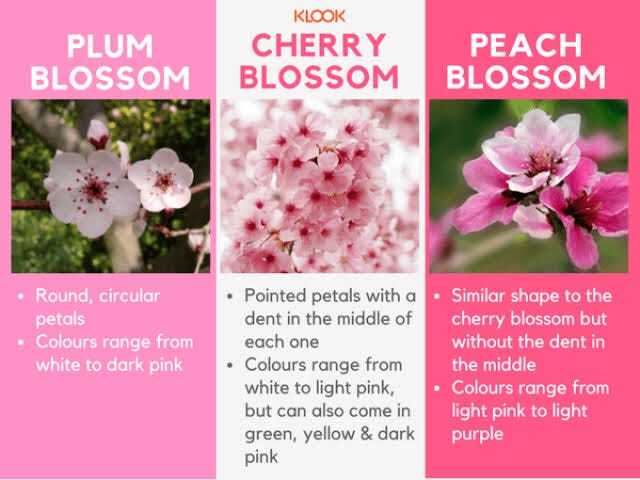
Start with the Man’yōshū, compiled in the second half of the eighth century. Of roughly 4,500 poems, about 1,500 mention plants. Plum - ume, an import from the continent along with Buddhism, Chinese script and Tang taste - appears in around 118 of them. Cherry appears in roughly 40 to 44, depending on how you count. Neither is the most frequent flowering plant in the anthology: that is hagi, bush clover, at around 140.
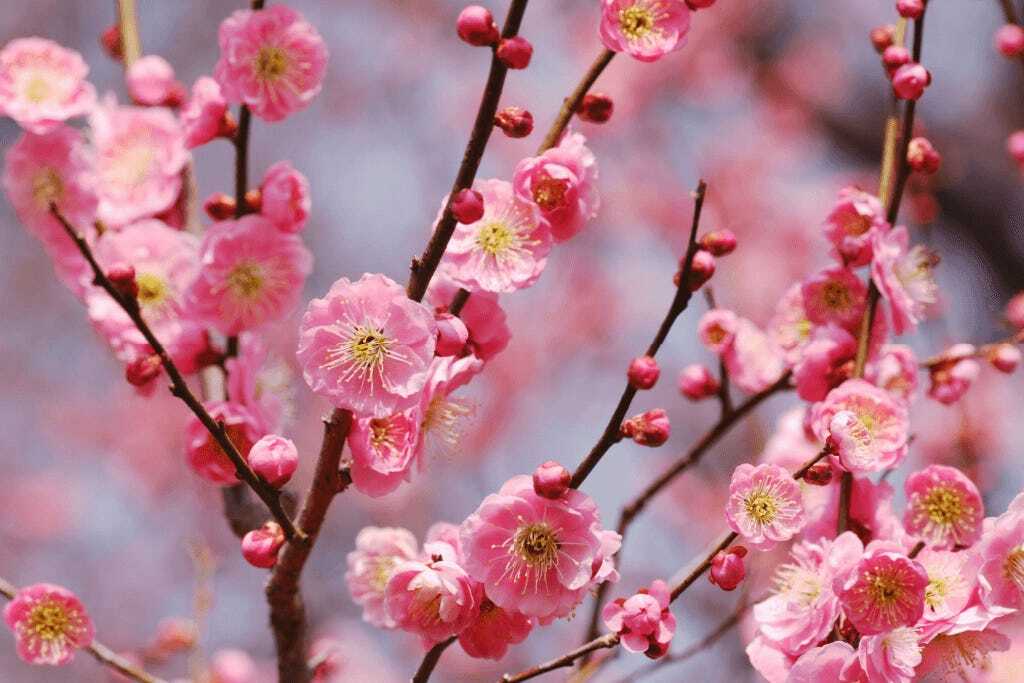
The ratio inverts during the Heian period. By the Kokinshū (c. 905) and after, hana - “the flower,” unqualified - means cherry. That much of the story is genuinely a thousand years old, and it includes the association with impermanence: Heian poets were already writing about scattering petals as a figure for transience, and by the Edo period the sentiment had hardened into proverb.
What is modern is the tree.
The cherry that produces the image everyone now has of a Japanese spring - an entire avenue erupting at once, then bare within a fortnight - is a single cultivar, Somei-yoshino. It is an interspecific hybrid of Edo higan and Ōshima cherry, it is self-incompatible, it cannot be reproduced true from seed, and it is propagated by grafting. Every Somei-yoshino in Japan and abroad is a clone of one original tree, a fact suspected by horticulturalists and confirmed by DNA analysis. Its origins lie in the nursery village of Somei, on the edge of Edo, at the very end of the Tokugawa period; the name attached to it in the course of a Tokyo park survey in the mid-1880s, when the trees at Ueno were catalogued. It was then planted by the hundreds of thousands across the newly modernizing country.
The simultaneity of bloom, in other words, is not a property of Japanese spring. It is a property of monoculture. The sakura zensen, the “cherry blossom front” tracked northwards each year by the meteorological services, is only forecastable because one genotype dominates so completely. Where wild mountain cherries grow, individual trees open days or weeks apart, and there is no front to track.
The national symbolism has an equally precise history. Emiko Ohnuki-Tierney has traced how the Meiji state took a flower that had signified cultural self-recognition, agrarian fertility, sociability and pleasure, and progressively bound it to the soldier’s death: cherry trees planted at Yasukuni Shrine from the 1870s, the fallen blossom identified with the fallen soldier reborn at the shrine, and finally the wartime formula instructing young men to scatter beautifully for the emperor. The tokkōtai units of 1944–45 flew with blossoms painted on their aircraft.
Here I would correct the compressed version of this story that circulates - including my own earlier, shorter one. The “fleeting blossom” is not a product of the 1930s. Impermanence was attached to falling cherry petals in classical poetry, and to warrior death in Edo proverb. What the 1930s and 1940s produced was something narrower and more consequential: the conversion of an aesthetic of transience into an instrument of state, a chain of equivalences running blossom → soul → sacrifice → emperor. The process begins in the 1870s and peaks in the war. Compressing it into a single decade makes the argument easier to state and harder to defend.
Wabi-sabi
Wabi-sabi as a single term, naming a single aesthetic, is a twentieth-century construction. In its current international form it is traceable to one slim book: Leonard Koren’s Wabi-Sabi for Artists, Designers, Poets & Philosophers, published by Stone Bridge Press in 1994. Koren has never claimed otherwise; his own website states that the book introduced the term to the non-Japanese world and that essentially every subsequent book on the subject rests on the conceptual scheme he laid out. Very few authors are in a position to make that claim about a supposedly ancient national aesthetic, and be right.
In Japanese, the two words come separate.
Sabi is a term of poetics, discussed above all within the Bashō school in the late seventeenth century, where it names a quality of tone - the loneliness or patina of an old thing, achieved in verse rather than admired in objects. Its genealogy runs back through sabishi in classical poetry.
Wabi belongs to the discourse of tea, crystallizing in the sixteenth century and codified in texts of the following century - many of which are retrospective. The Nanpōroku, the source most often quoted for Rikyū’s aesthetics, was compiled around 1690, a century after his death, and its status as testimony is exactly the sort of thing tea scholarship spends its time arguing about. Even within tea, wabiwas contested: a preference for rough, local, unnamed utensils against Chinese formality was a position in a live argument about status and value, not a settled national temperament.
The formula “the beauty of imperfection and impermanence” is a modern English sentence. It circulated in the West, met a receptive design culture in the 1990s and 2000s, and returned to Japan as an export commodity - where it is now used, with some irony, in domestic marketing and tourist-facing exhibition text.
But it would be careless to call this a purely Western invention. The packaging of Japanese aesthetics for foreign consumption was substantially a Japanese enterprise. Okakura Kakuzō wrote The Book of Tea (1906) in English, for an Anglophone readership, and it is the direct ancestor of every “Japanese aesthetics in one concept” book since. Yanagi Sōetsu’s mingei writings and D. T. Suzuki’s Zen essays did comparable work. Koren wrote the 1994 book, but he was working in a channel that Japanese intellectuals had built and used for the better part of a century.
Minimalism
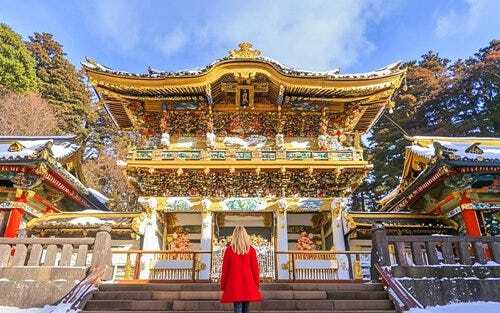
Bruno Taut arrived in Japan on 3 May 1933, a political refugee travelling via Siberia at the invitation of the Japan International Architectural Association. The following day - his fifty-third birthday - he was taken to the Katsura Detached Palace, the seventeenth-century villa of the Hachijō-no-miya princely house outside Kyoto. He recorded the visit in ecstatic terms and described himself in his diary as Katsura’s discoverer. He also visited Nikkō, and judged the Tōshōgū mausoleum complex - polychrome, gilded, densely carved - to be the low point of Japanese building, impressive only in scale.
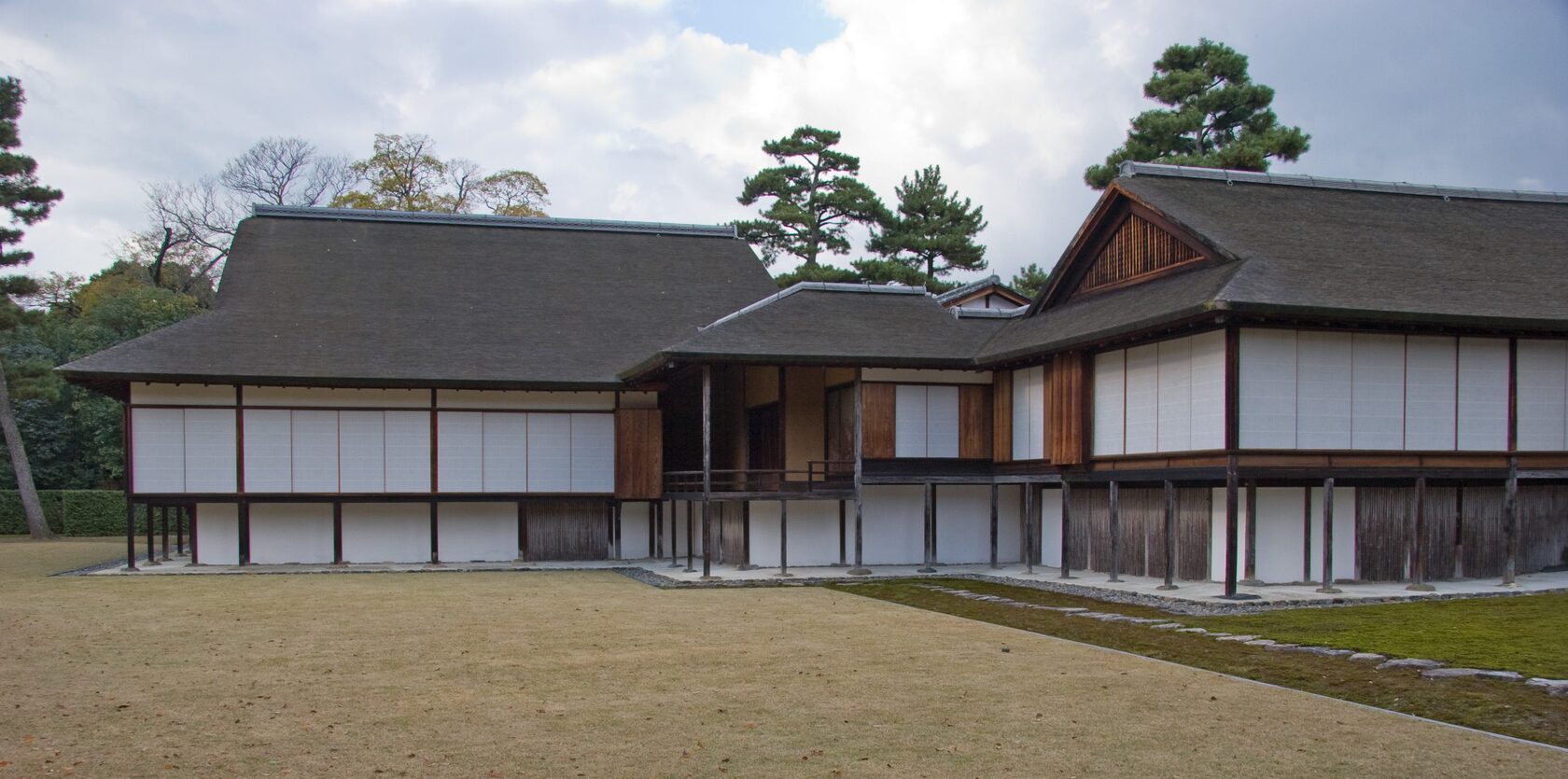
Thy did enormous work. A German modernist had inspected Japan’s building stock and certified which half of it was authentically Japanese. Modernist architecture, in Japan and abroad, accepted the verdict as a description of national taste rather than as what it was: a foreign professional’s aesthetic preference, arriving at a moment when Japanese architects had strong reasons of their own to want it confirmed.
Inoue Shōichi’s Tsukurareta Katsura rikyū shinwa - “The Invented Myth of Katsura,” 1986 - dismantled the discovery narrative. Japanese architects and critics were already constructing the Katsura canon before Taut’s visit; Taut was recruited into a project underway, and the claim to discovery is itself part of the myth. The canonization continued after him. The 1960 Yale volume Katsura: Tradition and Creation in Japanese Architecture - Ishimoto Yasuhiro’s photographs, essays by Walter Gropius and Tange Kenzō, designed by Herbert Bayer - presented the villa as a modernist object, and subsequent research has shown how heavily Tange cropped and sequenced Ishimoto’s images to produce the abstraction the argument required.
Meanwhile the material culture of Edo Japan, taken as a whole rather than as a curated selection, is dense, coloured and expensive: Momoyama gold-ground screens, the polychromy of Nikkō, urban kosode in saturated dyes and elaborate resist patterns, lacquer with gold. “Restraint” describes one strand of elite taste, cultivated in explicit opposition to the rest. It is a position within Japanese material culture, not a summary of it.
The case of ma (間) is more interesting than the standard debunking suggests. It entered international circulation through a single exhibition: Ma: Espace-Temps du Japon, conceived by Isozaki Aratafor the Festival d’Automne and shown at the Musée des Arts Décoratifs in Paris in 1978, then at the Cooper-Hewitt in New York in spring 1979 and onwards to Houston, Chicago, Stockholm and Helsinki. Roland Barthes, who did not participate in the exhibition proper but wrote short texts for its rooms afterwards, published a piece in Le Nouvel Observateur in October 1978 that fixed the word in French intellectual usage as the name for something Japanese that is neither space nor time but both.
Michael Lucken’s work on the term establishes the internal history. In premodern Japanese, ma is a technical word - the interval or distance required for the correct execution of a musical, theatrical or visual effect. It does not appear as an aesthetic ideal in Zeami or in the tea literature. Its use as a generic concept begins with the philosopher Nakai Masakazu around 1929–31, in explicit engagement with Heidegger and Oskar Becker; it spreads in Japan through the 1960s in the writings of Kurita Isamu, Itō Teiji and Isozaki himself; and only then does it go abroad.
So the useful correction is not “ma is a Western misunderstanding.” It is the reverse, and sharper: ma is a modern Japanese concept, built in dialogue with German phenomenology, which acquired its aura of untranslatable antiquity on export. The reason it seems ancient is that everyone involved - in Paris and in Tokyo - had an interest in it seeming so.
Kimono
The word 着物 means, transparently, “thing to wear.” For most of its history it was not the name of a category, because no category was needed. What made a category necessary was yōfuku, Western clothing. Once Meiji officials, officers and eventually the imperial household adopted Western dress - the Empress issued a statement encouraging women to do the same in 1887 - the remaining garments required a collective name, and wafuku / kimono became the term for national dress as opposed to modern dress. The kimono became visible as a tradition at the moment it stopped being the default.
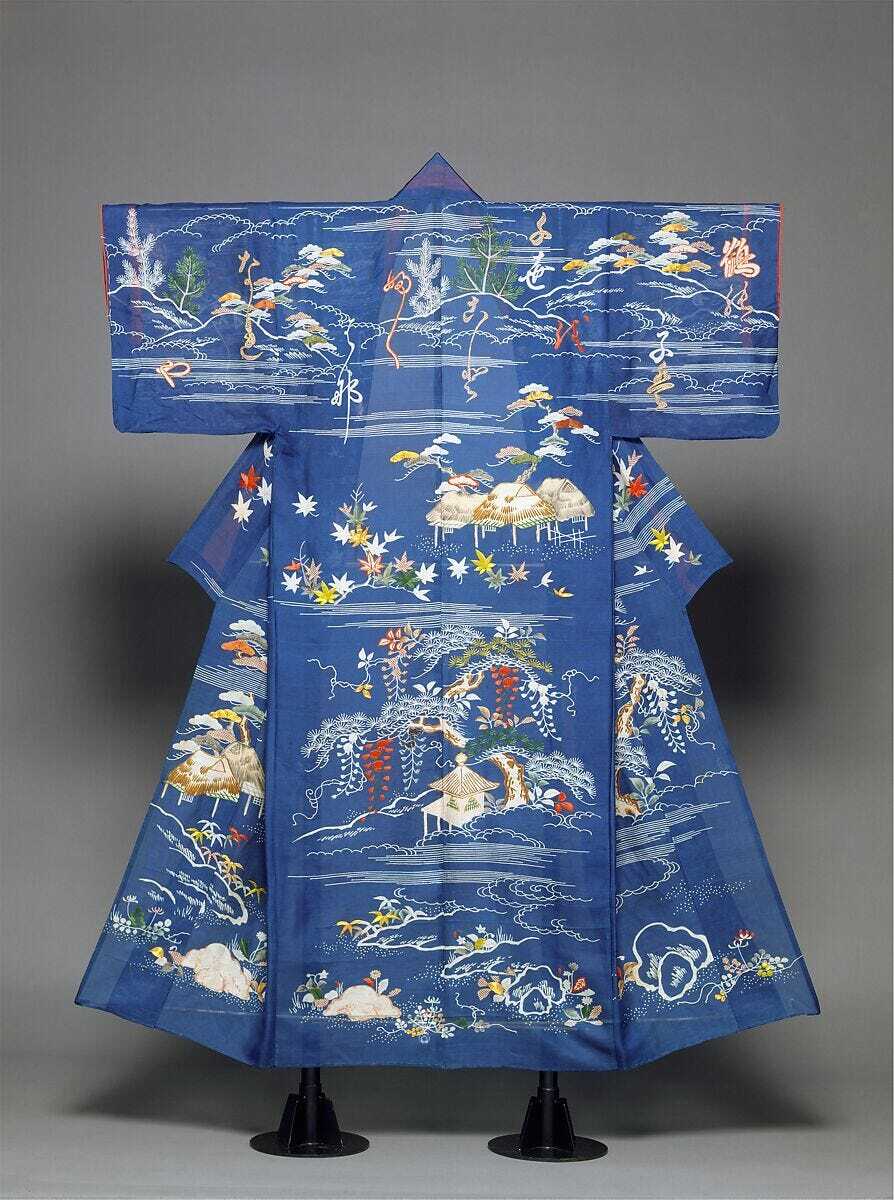
Before that, dress in Japan was regulated, but not by a unified etiquette. The court operated a system of forbidden colours (kinjiki) reserved by rank, with roots in the eighth century. The Tokugawa shogunate issued repeated sumptuary edicts restricting fabrics, dyes, embroidery and techniques by status group - silk denied to ordinary cultivators, purple and crimson reserved, elaborate shibori prohibited to townspeople. Donald Shively’s classic study of these regulations shows both their logic and their weakness: they were reissued again and again, which is the standard historical signature of a law being routinely evaded. Wealthy merchants responded by moving expenditure where the eye could not see it - into linings, into technically demanding but visually modest surfaces.
The point is that these were rules of who, not rules of when. Cloth and colour marked status, not occasion. There was no single grid covering the whole population and telling everyone what to wear to a wedding, because the population was not a single body of citizens with shared occasions.
The formality grid taught today - which kimono for which event, which crest count, which obi knot, which collar depth - was produced in two waves. The first is commercial: the department stores of the Meiji and Taishō periods, above all Mitsukoshi in the 1900s, which standardized, catalogued, promoted seasonal patterns and effectively took over the arbitration of taste. The second is postwar, and here I want to correct the version of this I published earlier. The kitsukeschools - the dressing academies that codified the rules into a teachable, certifiable system - are not a turn-of-the-century phenomenon. Sōdō Kimono Academy was founded by Yamanaka Norio in 1964; Hakubi Kyoto Kimono Gakuin in 1969. Their expansion belongs to the 1960s and 1970s.
The chronology matters, because it inverts the intuitive story. The rules did not become elaborate because the kimono was an ancient ceremonial garment. They became elaborate because the kimono had ceased to be ordinary clothing. Competence that had once been absorbed at home now had to be taught, examined and certified - and an institution that teaches a practice has every incentive to make it precise, difficult and gradable.
But how?
A category becomes visible only when it acquires an outside. Kimono needs Western clothing; ma needs “Western space”; Japanese restraint needs European ornament. Nothing needs a name until something threatens it or contrasts with it.
Modern institutions then standardize. Nurseries propagate one clone; department stores set the seasonal grid; academies issue certificates; ministries and festivals fix the calendar. Standardization is what converts diverse practice into a single describable tradition - and the standard is usually far younger than the practice.
Foreign validation is imported as authority. A German architect certifies the correct Japan; a French critic certifies the untranslatable concept; an American designer certifies the aesthetic of imperfection. In each case the certification was welcomed domestically, because it settled an argument that was already being conducted in Japanese.
And finally, the resulting formula is projected backwards. Once “the beauty of imperfection” or “the fleeting blossom” exists as a sentence, it becomes possible to find it everywhere in the archive, because the archive is enormous and any sentence can be illustrated from it.
None of this makes the objects less interesting. It makes them differently interesting. A cherry avenue in bloom is not a window into the eleventh century; it is a nineteenth-century horticultural product carrying a twentieth-century political inheritance, and that is a better story than the one on the postcard. The same holds for the tea bowl, the villa, and the garment.
Sources
Framework
- Eric Hobsbawm and Terence Ranger, eds., The Invention of Tradition (Cambridge University Press, 1983).
- Stephen Vlastos, ed., Mirror of Modernity: Invented Traditions of Modern Japan (University of California Press, 1998).
Cherry blossoms
- Emiko Ohnuki-Tierney, Kamikaze, Cherry Blossoms, and Nationalisms: The Militarization of Aesthetics in Japanese History(University of Chicago Press, 2002).
- Wybe Kuitert, “Botany and National Identities: The Tokyo Cherry,” Science in Context (Cambridge University Press) — on the Ueno park survey and the naming of Somei-yoshino.
- Wybe Kuitert, Japanese Flowering Cherries (Timber Press, 1999).
- Kenta Shirasawa et al., “Propagation Path of a Flowering Cherry (Cerasus × yedoensis) Cultivar ‘Somei-Yoshino’ Traced by Somatic Mutations,” DNA Research (2024), doi:10.1093/dnares/dsae025 — on clonality and propagation.
- Haruo Shirane, Japan and the Culture of the Four Seasons: Nature, Literature, and the Arts (Columbia University Press, 2012) — on “secondary nature” and the cultural construction of seasonal imagery.
Wabi and sabi
- Leonard Koren, Wabi-Sabi for Artists, Designers, Poets & Philosophers (Stone Bridge Press, 1994), and Wabi-Sabi: Further Thoughts (Imperfect Publishing, 2015), in which Koren describes his own role in introducing the term.
- Haga Kōshirō, “The Wabi Aesthetic through the Ages,” in Nancy G. Hume, ed., Japanese Aesthetics and Culture: A Reader (SUNY Press, 1995).
- Paul Varley and Kumakura Isao, eds., Tea in Japan: Essays on the History of Chanoyu (University of Hawai’i Press, 1989).
- Haruo Shirane, Traces of Dreams: Landscape, Cultural Memory, and the Poetry of Bashō (Stanford University Press, 1998) — on sabiwithin Bashō-school poetics.
- Okakura Kakuzō, The Book of Tea (1906) — as a primary document of the export packaging, not as a description of the sixteenth century.
Katsura, minimalism, ma
- Inoue Shōichi, Tsukurareta Katsura rikyū shinwa [The Invented Myth of Katsura Detached Palace] (Kōbundō, 1986; Kōdansha, 1997). In English, see his “The False Image of Katsura Detached Palace,” Japan Quarterly(1987).
- Bruno Taut, Fundamentals of Japanese Architecture (Kokusai Bunka Shinkōkai, 1936); Bruno Taut in Japan: Das Tagebuch, ed. Manfred Speidel (Gebr. Mann Verlag, 2013–2016).
- Walter Gropius, Tange Kenzō and Ishimoto Yasuhiro, Katsura: Tradition and Creation in Japanese Architecture(Yale University Press, 1960).
- Yasufumi Nakamori, Katsura: Picturing Modernism in Japanese Architecture (Yale University Press, 2010) - on Tange’s cropping and sequencing of Ishimoto’s photographs.
- Michael Lucken, “The Limits of ma: Retracing the Emergence of a ‘Japanese’ Concept,” Journal of World Philosophies 6 (Summer 2021): 38–57, doi:10.2979/jourworlphil.6.1.04.
- Isozaki Arata, Ma: Espace-Temps du Japon, exhibition catalogue (Musée des Arts Décoratifs, Paris, 1978; English edition, Cooper-Hewitt Museum, New York, 1979).
Kimono
- Terry Satsuki Milhaupt, Kimono: A Modern History (Reaktion Books, 2014).
- Liza Dalby, Kimono: Fashioning Culture (Yale University Press, 1993).
- Donald H. Shively, “Sumptuary Regulation and Status in Early Tokugawa Japan,” Harvard Journal of Asiatic Studies 25 (1964–65): 123–64.
- Ofra Goldstein-Gidoni, “Kimono and the Construction of Gendered and Cultural Identities,” Ethnology 38, no. 4 (1999), and her later work on the kimono in Japanese consumer culture.
- Yamanaka Norio, The Book of Kimono (Kodansha, 1982) - the founder of the Sōdō academy (est. 1964) setting out the system as doctrine; useful as evidence of when the rules were fixed.
Further reading
- Carol Gluck, Japan’s Modern Myths: Ideology in the Late Meiji Period(Princeton University Press, 1985).
- Takashi Fujitani, Splendid Monarchy: Power and Pageantry in Modern Japan (University of California Press, 1996).
- Jonathan M. Reynolds, “Ise Shrine and a Modernist Construction of Japanese Tradition,” The Art Bulletin 83, no. 2 (2001) — the same mechanism applied to Ise.
- Jordan Sand, House and Home in Modern Japan: Architecture, Domestic Space, and Bourgeois Culture, 1880–1930 (Harvard University Asia Center, 2003).
- Kim Brandt, Kingdom of Beauty: Mingei and the Politics of Folk Art in Imperial Japan (Duke University Press, 2007) — on Yanagi and the manufacture of folk authenticity.
- Christine M. E. Guth, Longfellow’s Tattoos: Tourism, Collecting, and Japan (University of Washington Press, 2004).
- Julia Meech and Gabriel P. Weisberg, Japonisme Comes to America: The Japanese Impact on the Graphic Arts, 1876–1925 (Harry N. Abrams, 1990) - the parallel case of ukiyo-e, revalued abroad before it was revalued at home.
20.08.2026
